[VISUAL:stats|## How Doma Protocol Rewires Domain Ownership Under the Hood:$5M|Seed round raised by D3 Global (2023),3.2M+|Total mainnet transactions (verify via Doma explorer),25,500+|Unique wallets on Doma (as of early 2025),6|Registrar partners building on Doma]
To understand NicNames, you first need to understand the infrastructure it's built on.
Doma Protocol (built by D3 Global) is the world's first DNS-compliant blockchain designed specifically for tokenising traditional internet domains. That phrase is doing a lot of work, so let me unpack it.
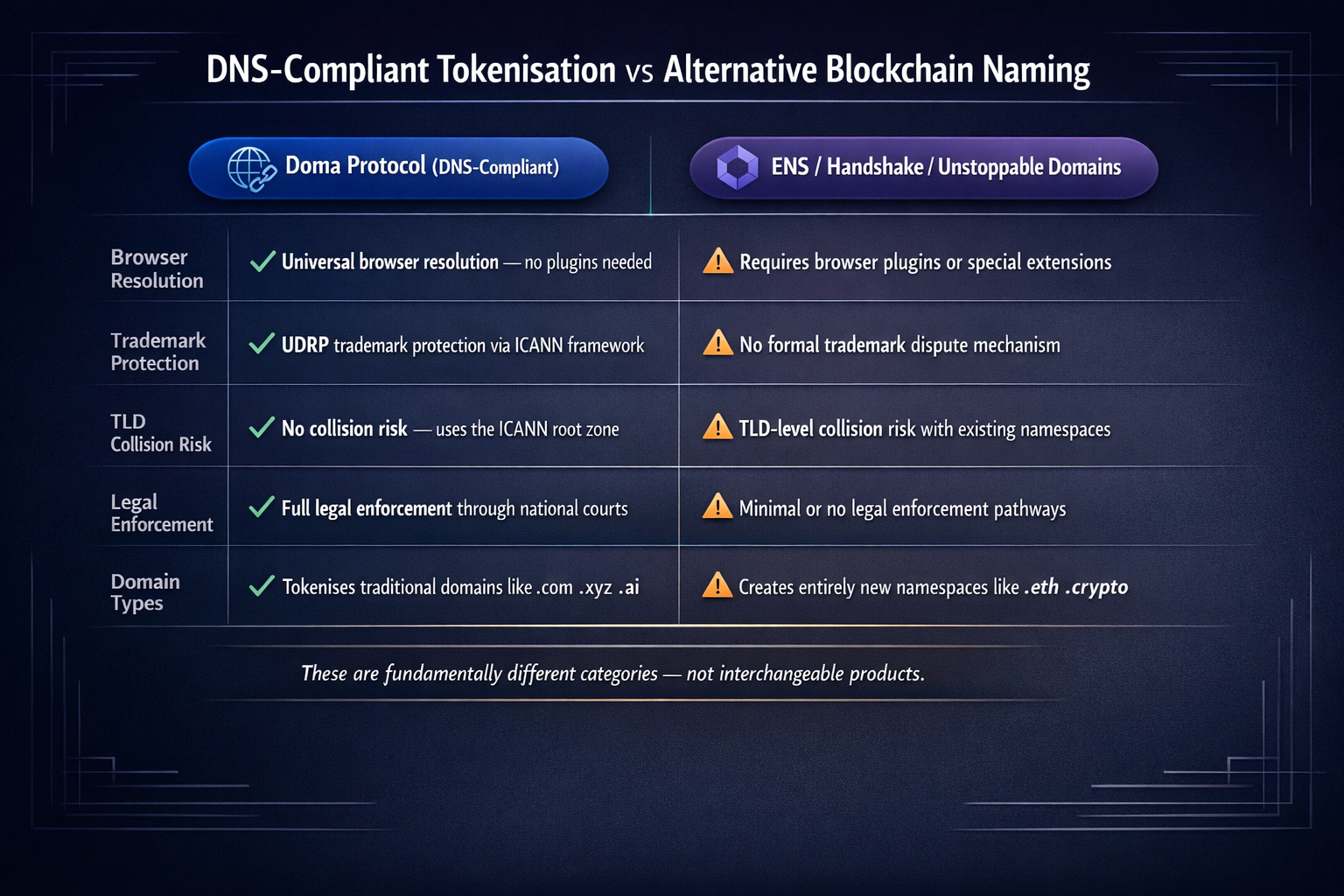
DNS stands for Domain Name System — the internet's phone book that translates human-readable addresses (like google.com) into the numerical IP addresses that computers actually use. DNS-compliant means Doma doesn't create a parallel naming system the way ENS (Ethereum Name Service) or Handshake does. It works inside the existing DNS infrastructure, which means a domain tokenised on Doma still resolves in every browser on earth without plugins, extensions, or special software.
Technically, Doma is an EVM-compatible Layer 2 built on the OP Stack — the same open-source rollup stack that powers Optimism and Base. Think of it as a specialised blockchain that runs on top of Ethereum, inheriting Ethereum's security while processing domain transactions faster and cheaper.
D3 Global (the company behind Doma) raised a $5 million seed round in 2023. Further funding details, including any subsequent rounds and specific investor participation, should be verified against D3 Global's official announcements. (Note: some earlier versions of this article cited a $25M Series A led by Paradigm in January 2025 — we have been unable to independently verify this figure against Paradigm's public portfolio or D3 Global press releases and have removed the claim pending confirmation. We have also been unable to independently confirm participation by Coinbase Ventures or Sandeep Nailwal in a specific round. If readers have primary sources confirming these details, please contact our editorial team.)
The on-chain metrics since mainnet launch tell the early story: 3.2 million-plus transactions and over 107,000 tokenised domains as of early 2025, according to Doma's public data (these figures should be verified against the Doma block explorer for the most current numbers). The unique wallet count exceeds 25,500, though it's worth noting that unique wallet counts on L2s can be inflated by airdrop farming — one person operating multiple wallets — so this is a proxy for activity rather than a definitive user-adoption metric.
Here's the critical distinction that most coverage misses: Doma is not a registrar. It doesn't sell domains. It's infrastructure that registrars build on top of — the same way Stripe is payment infrastructure that merchants build on. NicNames is the registrar. Doma is the protocol. You buy your domain from NicNames. Doma handles the on-chain tokenisation underneath.
The Dual-Token Model
Doma uses a dual-token model that separates two things that have always been bundled together in traditional domain ownership:
- ›DOTs (Domain Ownership Tokens) represent ownership and transfer rights — think of these as your digital title deed
- ›DSTs (Domain Settings Tokens) represent DNS control — the ability to decide where the domain actually points
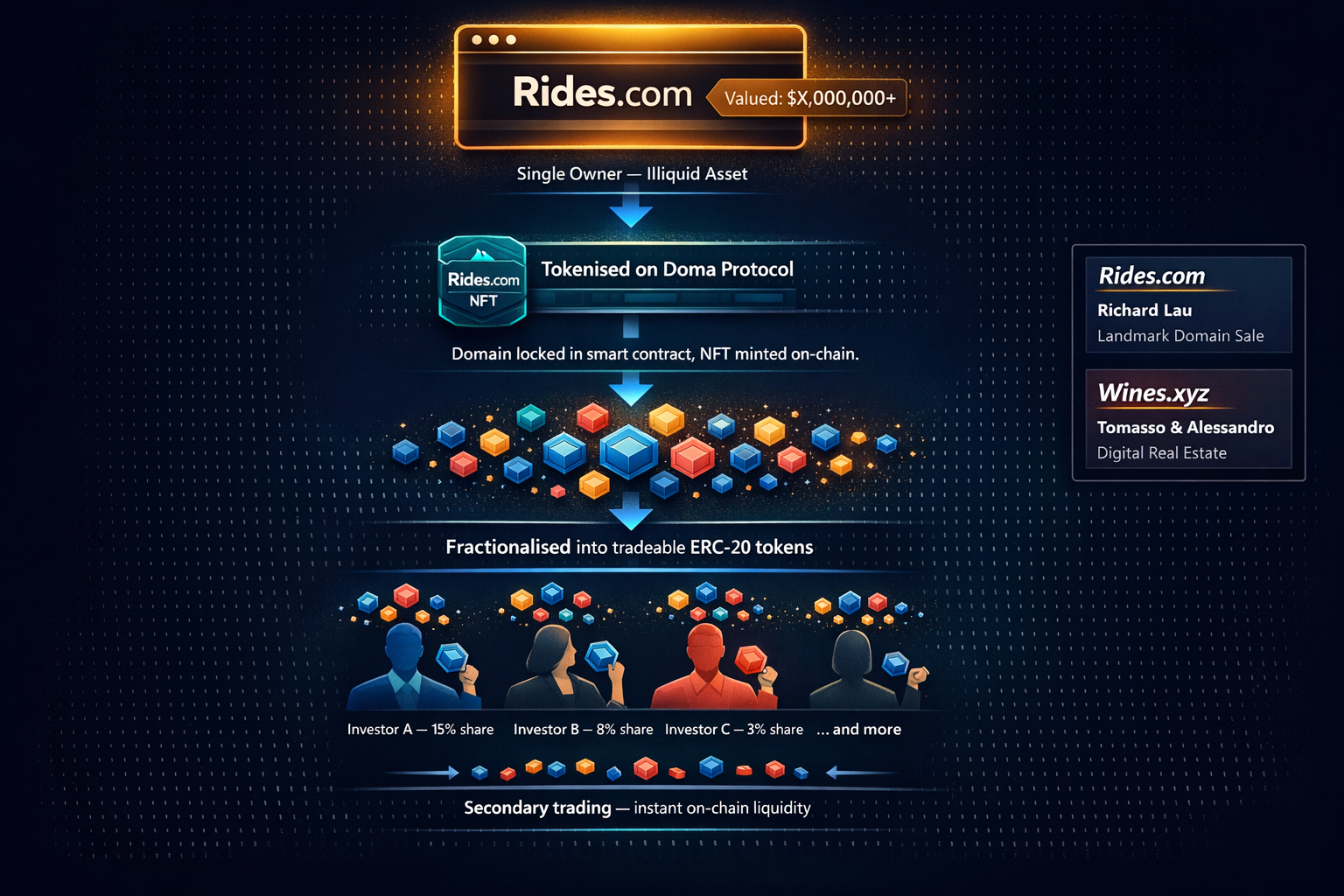
(Note: the exact token standard for DOTs and DSTs — whether ERC-721, ERC-1155, or a custom implementation — should be verified against Doma Protocol's technical documentation. Because each domain is unique, ownership tokens would logically be non-fungible rather than fungible ERC-20 tokens. Readers should consult Doma's developer docs for the canonical specification.)
This separation is subtle but powerful. It means you can trade ownership of a domain (by transferring DOTs) while keeping the website live and functional (because the DSTs controlling DNS haven't moved). Or you can delegate DNS management to a technical operator without giving up ownership. For businesses tokenising valuable domains, this is the difference between a useful tool and a non-starter.
However, it's important to understand the governance relationship between these tokens. Key questions to verify against Doma's documentation: Can the new DOT holder force a DST transfer or revoke existing DSTs? What smart contract logic prevents a former owner from redirecting DNS maliciously after selling the DOT? In most standard tokenisations through NicNames, the same entity holds both DOT and DST — the separation is a capability that becomes relevant in advanced use cases (delegation, fractionalisation) rather than the default user experience.
Who Actually Owns the Domain?
This is the most important question the dual-token model raises, and one that requires careful attention: does holding a DOT make you the legal owner of the domain, or does the registrar (NicNames) remain the registrant of record at the registry level?
In the traditional domain system, the registrant of record at the registry (e.g., Verisign for .com) is the legal owner. If NicNames remains the registrant at the registry level and you merely hold a token representing a claim, you have token ownership, not necessarily domain ownership in the legal and ICANN-recognised sense. This distinction matters enormously: in a dispute, the registry-level record likely prevails over on-chain state.
Prospective users should clarify this with NicNames and review Doma's documentation before tokenising high-value domains. The on-chain record provides strong evidence of intent and transaction history, but its legal enforceability as proof of domain ownership may vary by jurisdiction and has not been tested in court.
Comparison with Other Tokenisation Approaches
Doma is not the only project tokenising domains, and a complete picture requires acknowledging alternatives:
- ›ENS (.eth) creates a native blockchain naming system on Ethereum — powerful within the crypto ecosystem but requires ICANN recognition for mainstream browser resolution
- ›Handshake replaces ICANN's root zone entirely with a decentralised alternative — ambitious but creates TLD collision risk and fragmentation
- ›Unstoppable Domains (.crypto, .x, .wallet) tokenises domains outside the ICANN root, with some DNS resolution support but limited browser compatibility without extensions
- ›Doma Protocol tokenises existing ICANN-root domains (.com, .xyz, .ai) without creating a new namespace — maintaining universal browser resolution and UDRP protection
The key differentiator is that Doma works within the existing DNS, while the others build parallel or replacement systems. For domain industry professionals whose assets are ICANN-root domains, Doma is the only approach that tokenises what they already own.
What this means for you: Doma is the settlement layer — like SWIFT for banks. NicNames is the bank branch you walk into. You interact with NicNames; Doma clears the transaction underneath. But unlike a bank, the question of who legally holds your asset at the deepest infrastructure level (the registry) is one you should answer before committing high-value domains.