Things I Learned About Domains from My Interview with Tom Barrett, Founder of EnCirca
Covers why ICANN veteran Tom Barrett sees Doma Protocol as the first viable Web3 naming system and why ENS, Handshake, and Unstoppable Domains have fatal structural flaws. After reading, you can evaluate any blockchain naming project using Barrett's five-point mainstream-readiness test.
→Apply Barrett's five-point test to any blockchain naming project before investing
→Distinguish regulated TLDs like .bank and .pharmacy from open-registration extensions
→Identify why ENS and Handshake fail universal browser resolution requirements
→Explain how Doma's dual-token DOT/DST architecture separates ownership from DNS control
01
From Jet Engines to Domain Names: Tom Barrett's Unlikely Path
Tom Barrett's career is a sequence of systems where failure has real-world consequences: jet engine automation, legal-grade information services, and ICANN-regulated domain infrastructure. Before he ever touched a domain name, he was a mechanical engineer designing factory automation for jet engine manufacturers — systems where a single flaw could bring down an aircraft. He moved to Thomson Reuters, a company whose entire value proposition rests on information being accurate and trustworthy. Then he created SAGES, one of the first internet services built specifically for trademark lawyers. And in 2001, he founded EnCirca, an ICANN-accredited registrar that has now operated continuously for twenty-five years.
I sat down with Tom expecting to talk about domains. His answers gave me a concrete framework for separating technology built to survive regulatory and engineering scrutiny from technology that only needs to survive a pitch deck. Below is exactly what I took away — and why several projects I previously considered promising now look structurally broken.
Here is what this piece covers: why the engineer who builds systems for regulated industries believes Doma Protocol is the first Web3 naming approach that can actually go mainstream, why every alternative blockchain domain system has a fatal structural flaw, and why the next massive wave of domain buyers will be people who just lost their jobs to AI.
What this means for you: Tom's career is a filter. If a twenty-five-year ICANN-accredited registrar specialising in the most trust-sensitive domains on the internet puts his name behind something, the compliance bar has already been cleared at a level most crypto projects never reach.
---
02
What Makes .bank Different from .com: The World of Regulated TLDs
Most people think a TLD — the letters after the dot, like .com or .org — is just a cosmetic choice. Tom's entire business proves otherwise.
EnCirca specialises in regulated TLDs: .bank, .pharmacy, and .post. These are not open-registration extensions where anyone with a credit card can grab a name. To register a .bank domain, you must prove you are a licensed financial institution. To register .pharmacy, you must be a verified, licensed pharmacy. .post is reserved for postal service operators. The verification happens at the registrar level — it is enforcement, not suggestion.
›.bank exists because phishing attacks on financial institutions cost billions annually. A consumer seeing a .bank domain knows the site belongs to a real bank — that trust is baked into the TLD's rules, not left to the user to figure out.
›.pharmacy exists because counterfeit online pharmacies are a public health crisis. The TLD serves as a signal that the operator has been vetted.
›.post anchors the digital identity of postal services worldwide.
›There are roughly ~360 million domain names registered globally across hundreds of TLDs, according to Verisign's most recent Domain Name Industry Brief (though this figure fluctuates quarterly). The vast majority sit in open-registration extensions like .com and country-code TLDs like .uk or .de. Regulated TLDs are a small fraction — but they represent the highest-trust layer of the namespace.
What this means for you: Regulated TLDs teach us something that applies to every domain and blockchain project: trust is not a feature you bolt on later. It is either designed into the system's architecture from day one, or it is absent. Tom's background in these high-verification domains is the lens through which he evaluates everything else — including blockchain-based naming.
---
03
Why ICANN Still Runs the Internet's Address Book
Before we can evaluate Tom's technical critique of alternative naming systems, we need to understand the infrastructure they are trying to replace — or work alongside.
ICANN — the Internet Corporation for Assigned Names and Numbers — manages the DNS root zone, the master directory that tells every device on the internet which servers are authoritative for which domain names. Here is why this matters more than most crypto commentary acknowledges:
›Single authoritative root. There is one global namespace. When you type google.com into any browser, on any device, in any country, it resolves to the same place. This universality is not a convenience — it is the foundation that makes the web usable.
›UDRP dispute resolution. The Uniform Domain-Name Dispute Resolution Policy is ICANN's arbitration system for trademark-versus-domain conflicts. It lets a brand owner challenge a domain registered in bad faith without filing a full lawsuit. Trademark owners have a structured, relatively affordable arbitration path. This is not perfect, but it provides a level of legal certainty that institutions require before building their digital presence on a naming system.
›Registrar compliance. ICANN-accredited registrars like EnCirca undergo financial audits, technical infrastructure reviews, and ongoing compliance obligations. Accreditation is not a one-time achievement — it is a continuous process. EnCirca has maintained it for twenty-five years.
›WHOIS and RDAP databases provide registrant data (subject to privacy laws like GDPR, which has created its own set of tensions with ICANN's transparency goals). There are consequences for abuse within this system.
›Institutional trust. Governments, banks, hospitals, and Fortune 500 companies all build their digital identities on ICANN domains. That trust took decades to earn. A smart contract deployed yesterday inherits none of it, regardless of its code quality.
The crypto-native instinct is to view centralised governance as a flaw. Tom's perspective — shaped by building systems for jet engines, legal compliance, and institutional trust — is that governance is what makes a naming system viable for the real world. Code and law must coexist. That said, ICANN's governance is not without legitimate criticism: accountability gaps, the ongoing tension between WHOIS transparency and GDPR compliance, the controversial attempted sale of the .org registry in 2019, and rising registration costs have all drawn scrutiny. Tom's point is not that ICANN is perfect — it is that its framework of accountability, however imperfect, is a prerequisite for institutional adoption.
What this means for you: Any project claiming to replace ICANN is fighting against the network effects of ~360 million domains, universal browser support, and decades of institutional adoption. The smarter play — the one Doma Protocol takes — is to work inside that system while adding on-chain capability.
---
04
Tom's Technical Critique: Why ENS, Handshake, and Unstoppable Domains Can't Go Mainstream
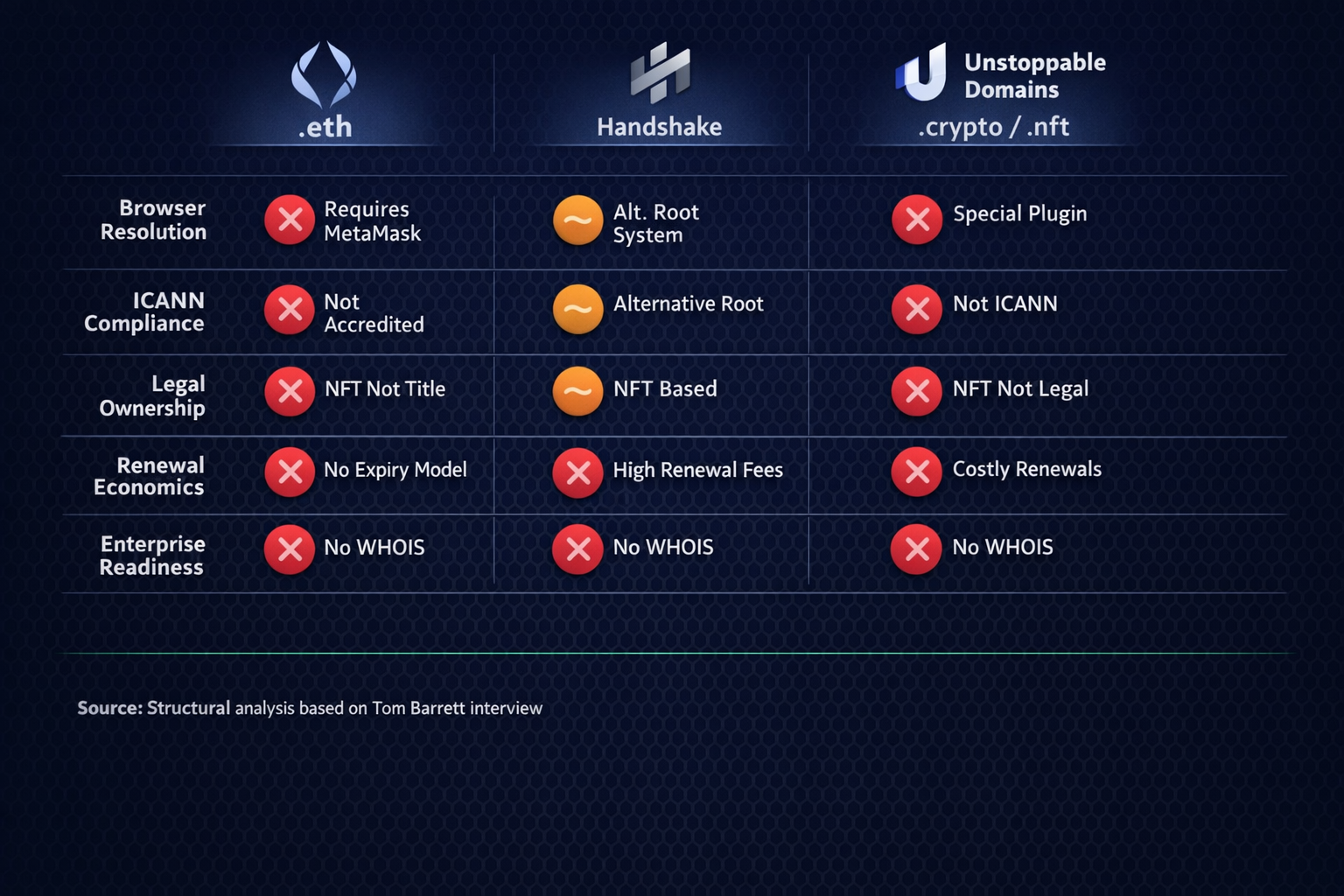
A comparison matrix showing how ENS, Handshake, and Unstoppable Domains each fail against five struc
This is where most explanations of Web3 domains go wrong. They frame ENS (Ethereum Name Service, which offers .eth domains), Handshake (a blockchain that allows users to bid on and register new top-level names via auction on an alternative DNS root), and Unstoppable Domains (which sells .crypto, .nft, and similar extensions) as the future of internet naming. Tom sees five structural problems that prevent any of them from reaching mainstream adoption. Not "might prevent." Prevent.
It is worth noting that Doma is not the first attempt to bridge DNS-compliant domains onto blockchain infrastructure. Namebase built a marketplace for Handshake names, and various NFT-domain bridge projects have attempted similar tokenisation of traditional domains. Most stalled due to the structural problems Tom identifies below — particularly the inability to operate within the ICANN root and the absence of universal browser resolution. Understanding why predecessors failed sharpens the case for what Doma does differently.
1. No universal browser resolution. Type a .eth address into Safari, Chrome, or Firefox right now. Nothing happens — unless you have installed a specific plugin or wallet extension like MetaMask. A domain that requires a browser extension to resolve in any mainstream browser is functionally broken for general audiences. This is a binary test: either a name resolves everywhere, or it does not resolve reliably anywhere. ICANN domains pass. Every alternative naming system fails.
2. TLD collision risk. Handshake uses an auction mechanism — specifically a Vickrey-style blind auction requiring HNS token bidding — to let users bid on top-level names on its own alternative root. Some of those names — like .wallet or .music — may later be officially delegated by ICANN to a legitimate operator. When that happens, the same string resolves to different destinations depending on which root your device uses. This breaks the fundamental promise of a single, global namespace. This is not theoretical; ICANN has already delegated new gTLDs that overlap with Handshake names.
3. No UDRP enforcement. ENS and Handshake have no equivalent to ICANN's dispute resolution system. Someone can register CocaCola.eth and there is essentially zero recourse through the naming system itself. Without a structured arbitration mechanism, institutions will not build their digital presence on these systems.
4. No accountability for bad actors. In the ICANN system, registrars are bound by contractual obligations. WHOIS and RDAP databases provide registrant data (subject to privacy laws). There are consequences for abuse. In alternative naming systems, there is no contractual relationship, no registrar obligations, and no dispute resolution body. A cybersquatter or phishing operator faces near-zero consequences from the naming infrastructure itself.
5. Fragmented ecosystems. Each alternative system has its own namespace, its own user base, its own resolution chain. None interoperate with each other or with the ICANN root. This fragmentation divides an already small user base into even smaller pools.
Tom's diagnosis is blunt: friction kills adoption. If someone has to install software, learn a new resolution chain, or accept that their domain won't work in certain browsers, the system will remain a niche curiosity regardless of its technical elegance.
What this means for you: Before you invest time or money in any blockchain naming project, apply Tom's five-point test. If it fails even one of these — especially universal browser resolution — the path to mainstream adoption is structurally blocked.
---
05
Doma Protocol: The First Web3 Naming Approach Capable of Going Mainstream
Tom called Doma Protocol the first Web3 naming approach capable of going mainstream. Coming from someone who has spent twenty-five years inside the ICANN compliance framework, that is not a casual statement.
Here is why it is structurally different from everything else in the space. Doma does not create new TLDs. It does not build a parallel namespace. It tokenises real, DNS-compliant domains — .com, .ai, .xyz, and hundreds of other extensions — as programmable assets on an EVM-compatible Layer 2 blockchain built on the OP Stack (the same open-source framework behind Optimism). According to Doma, mainnet is scheduled to launch on November 25, 2025, though readers should verify the current status via Doma's official channels, as timing may shift. The project has received backing from Paradigm — which participated in an earlier funding round — along with Coinbase Ventures and Sandeep Nailwal, co-founder of Polygon, who also participated as an investor. (Note: the specific round size and stage should be verified against Doma's official announcements; earlier reporting confirmed a $5M seed round with Paradigm participation, while Doma has referenced larger subsequent funding that has not been independently verified via Crunchbase or Paradigm's portfolio page at time of writing.)
The Dual-Token Architecture
The dual-token architecture is more sophisticated than a simple "one NFT equals one domain" model. DOTs (Domain Ownership Tokens) represent ownership and transfer rights for a specific domain. DSTs (Domain Settings Tokens) represent DNS control — the ability to point the domain at a specific server. This separation means you can sell a domain's ownership while granting the buyer time to configure their DNS, or hold a domain purely as a financial asset without ever setting it up to resolve. Think of it like real estate: the title (DOTs) and the lease (DSTs) can be handled independently.
Important technical note: Because each DOT represents a unique domain, these tokens must use a non-fungible token standard (such as ERC-721 or ERC-1155) rather than ERC-20, which is a fungible token standard where every token in a contract is identical. Readers should verify the precise token standard against Doma's current technical documentation and smart contract architecture, as this distinction affects what a buyer actually receives on-chain.
How On-Chain Ownership Maps to Off-Chain DNS Control
This is the critical question the entire system depends on: how does holding a DOT on-chain translate into ICANN-recognised domain ownership in the off-chain DNS?
The bridge works through Doma's registrar partners. When a domain is tokenised, the registrar partner (such as EnCirca or NicNames) locks the domain's registration status and links it to the on-chain token. When a DOT transfers to a new wallet, the registrar partner updates the WHOIS/RDAP records to reflect new ownership. The DST controls DNS zone file settings independently, allowing the new owner to point the domain at their servers.
This architecture means the system's trustworthiness depends on the oracle/bridge between on-chain token state and off-chain DNS records. Key questions readers should consider:
›Who operates the sync? The registrar partners perform the off-chain DNS updates when on-chain token transfers occur.
›What is the latency? DNS propagation after an ownership change typically takes minutes to hours, not the seconds of on-chain settlement.
›What happens if the bridge fails? If a registrar partner goes offline, is compromised, or acts maliciously, the on-chain token and off-chain DNS record could fall out of sync. This is a trust assumption — you are trusting Doma's registrar partners and their integration infrastructure, not just code.
›What governance controls the bridge? Doma's documentation should specify what happens in edge cases. Readers considering significant capital deployment should review Doma's technical documentation on bridge security before proceeding.
Smart Contract Security
Any article discussing infrastructure that handles significant transaction volume should address smart contract security. Readers should verify whether Doma's smart contracts have been independently audited, by which firm(s), and whether audit reports are publicly available. Before interacting with any on-chain protocol, reviewing publicly available audit reports — or noting their absence — is basic due diligence.
Critically, Doma is not a registrar. It is infrastructure that registrars build on top of. EnCirca, NicNames, InterNetX, Rumahweb, ConnectReseller, and Interstellar are the registrar partners. As Elias Benger of InterNetX put it in a previous conversation I had with him: "They're not selling a product, they're selling a platform — infrastructure anyone can build on. If we get users on it, everybody wins."
What this means for you: A tokenised domain on Doma is still a real domain. It resolves in every browser. It has UDRP protection. It has all the legal and technical infrastructure of the ICANN system. And now it also has 24/7 on-chain tradability, programmable ownership, and instant settlement. That combination is what makes Doma structurally different from previous attempts. You can explore the marketplace yourself at app.doma.xyz.
---
06
On-Chain vs Traditional: How Domain Trading Actually Changes
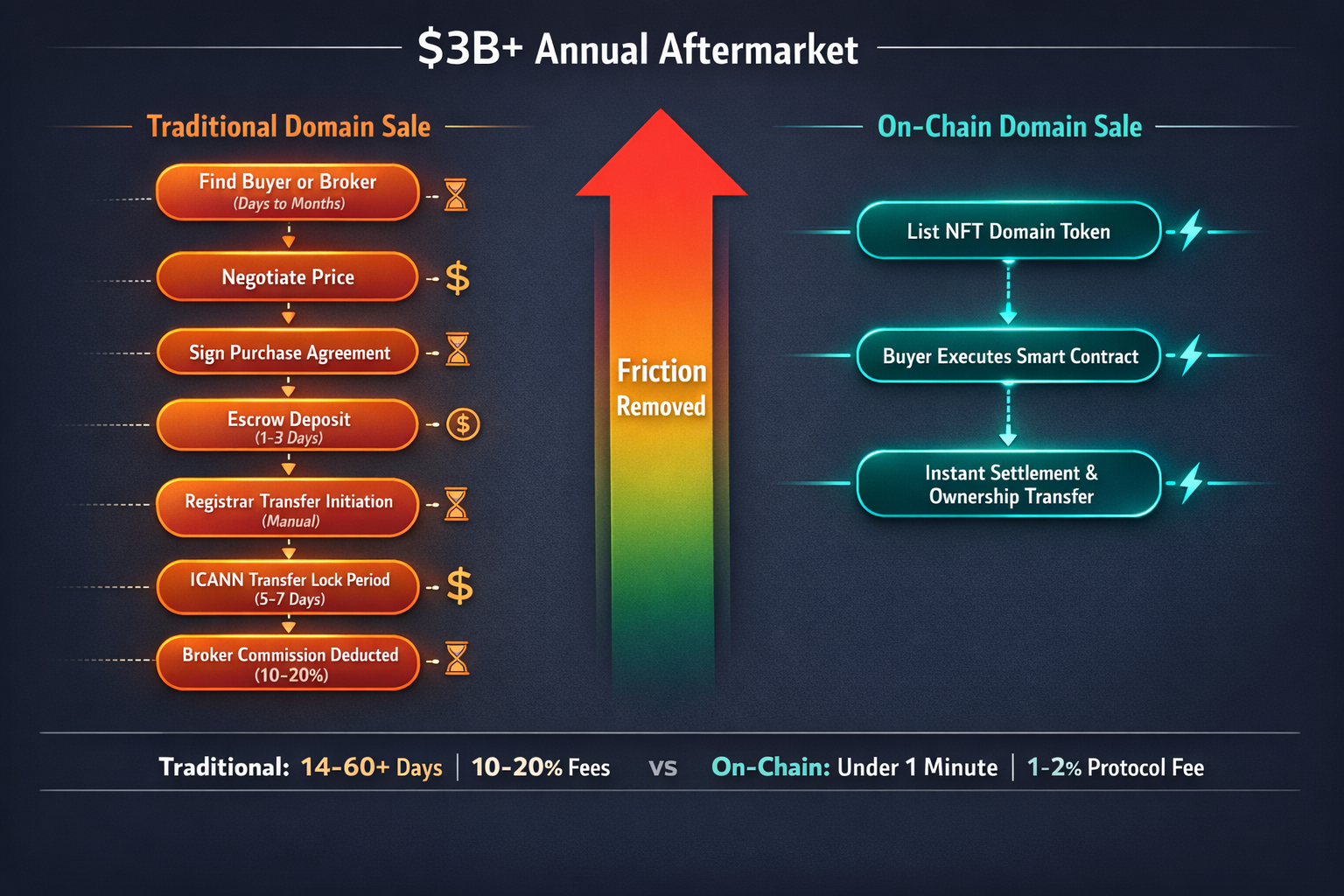
A sidebyside flow diagram contrasting the slow multistep traditional brokered domain sale process wi
The domain aftermarket — the secondary market where previously registered domains are bought and sold — is estimated at over $3 billion annually, according to aggregated data from platforms like Sedo, Afternic, and GoDaddy, supplemented by estimates from DNJournal and NameBio. The actual figure is notoriously opaque because most high-value domain deals are private and unreported — the real number could be significantly higher. The aftermarket has existed for roughly thirty years. And for most of that time, the process has been painfully slow.
Here is how a traditional domain sale works: you find a buyer (or hire a broker), negotiate a price, the broker takes a 10–20% commission (depending on deal size and broker — GoDaddy's brokerage charges up to 20% on lower-value domains, while Sedo and independent brokers typically charge 10–15%), both parties deposit funds and the domain into an escrow service (a neutral third party that holds both until the deal closes), and the transfer settles in two to four weeks. If something goes wrong — a dispute, a miscommunication, a technical hiccup — the timeline stretches further.
On Doma, the same transaction looks fundamentally different:
1. Buyer and seller connect on-chain. No broker required, though one can still be used.
2. Smart contract holds the terms. The domain's DOTs and the buyer's payment (in stablecoins or other tokens) are locked in a smart contract — code that executes automatically when conditions are met.
3. On-chain settlement is near-instant. The moment the buyer's funds and the seller's DOTs are in the contract, the swap executes. However, "settlement" here means the on-chain token transfer — the downstream DNS update through the registrar partner may take additional time. This is faster than traditional escrow by orders of magnitude, but it is not truly instantaneous end-to-end.
4. Available 24/7. No business hours, no time zones, no waiting for an escrow company to open on Monday.
5. No broker commission on the protocol level. Note that this does not necessarily mean zero fees — most DeFi protocols and NFT marketplaces charge protocol fees (OpenSea charges 2.5%, Blur charges 0.5%, for example). Readers should verify whether Doma charges any protocol-level transaction fees. Even without broker commissions, the savings on a six-figure domain can be significant.
A note on "counterparty risk": On-chain trading changes the nature of counterparty risk rather than eliminating it entirely. You are no longer trusting a human escrow agent — but you are trusting smart contract code (and the team that deployed it), the bridge between on-chain tokens and off-chain DNS, and the registrar partner's operational integrity. Smart contract exploits have resulted in billions of dollars in losses across DeFi. The risk is different, and in many ways reduced, but it is not absent. Readers unfamiliar with DeFi exploit history should understand this distinction.
How the DOT/DST Split Prevents Post-Sale Manipulation
The dual-token architecture directly addresses a common fear in domain trading: what if the seller manipulates DNS records after the sale? Here is how it works in practice:
When a DOT (ownership token) transfers to the buyer via smart contract, the seller loses the ability to control the domain's DNS settings — that control transfers with the DST. If both the DOT and DST transfer atomically in the same transaction, the seller cannot retain DNS control after the ownership change. If a seller attempted to point DNS records elsewhere before the sale completes, the atomic swap means either the entire transaction executes (funds, DOT, and DST all change hands) or none of it does. The smart contract does not allow partial execution.
This is a genuine improvement over traditional aftermarket transactions, where a seller could theoretically delay DNS transfer after receiving escrow funds, creating a window of vulnerability.
Gas Fees and Transaction Costs
The article would be incomplete without discussing the actual costs of on-chain domain trading. On Doma's OP Stack L2, individual transaction fees are typically fractions of a cent — significantly cheaper than Ethereum mainnet, where the same operations could cost $5–50+ during network congestion. However, readers should also consider:
›Bridging costs: Moving stablecoins or ETH from Ethereum mainnet to Doma's L2 incurs bridging fees and mainnet gas costs.
›Stablecoin acquisition costs: Converting fiat to stablecoins involves exchange fees (typically 0.1–1.5% depending on the platform).
›Total cost comparison: Even accounting for bridging and acquisition, on-chain transaction costs for a five-figure domain sale are likely to be a small fraction of traditional escrow + broker fees. But the savings are most dramatic on high-value transactions — for a $10 domain, the overhead of getting stablecoins onto the L2 may exceed any savings.
If you already hold crypto and need to swap into stablecoins for a Doma transaction, a no-KYC swap service like ChangeNOW lets you bridge between chains and assets without creating new exchange accounts — useful for quick conversions, though readers should note that no-KYC services may carry different regulatory implications depending on jurisdiction.
Between Ownership and Expiry: What Happens When a Tokenised Domain Lapses
This is the single biggest gap between "owning an NFT" and "owning a domain" — and readers must understand it clearly.
A tokenised domain is still subject to ICANN renewal cycles. Domain registrations must be renewed periodically (typically annually), and if the underlying registration lapses, the on-chain token becomes effectively worthless. Holding a DOT does not exempt you from paying renewal fees to the registrar. If you let the registration expire:
›The domain enters a grace period, then a redemption period, then drops to the open market — regardless of what the on-chain token says.
›A third party could re-register the expired domain, leaving the original DOT holder with a token that points to nothing.
›The on-chain token and off-chain registration can fall out of sync if renewals are not maintained.
Before acquiring any tokenised domain, verify: How are renewals handled? Does the registrar partner send renewal notices? Is there any on-chain mechanism that flags approaching expiry dates? Who is responsible for renewal — the DOT holder or the registrar? These are not hypothetical concerns — they are the practical reality of any domain asset, tokenised or not.
According to Doma's on-chain dashboard, early activity metrics include $38M+ in volume, 3.2M+ transactions, and 107,000+ tokenised domains — though these figures should be independently verified as they come from Doma's own reporting and were not confirmable via third-party on-chain analytics at time of writing. If accurate, those 107,000 tokenised domains represent roughly 0.03% penetration of the ~360 million domains registered worldwide. However, this comparison is conceptually imprecise: most of those 360 million domains are active websites, parked pages, or defensive registrations that will never be traded. The tradeable aftermarket is a much smaller fraction of total registrations, making Doma's actual penetration of the addressable market somewhat higher than 0.03% — though still early.
What this means for you: On-chain domain trading changes how domains move — faster, with different cost structures, and with different (not absent) risk profiles. But a tokenised domain is still a domain: it must be renewed, it exists within the ICANN system, and the on-chain layer adds functionality without removing real-world obligations.
---
07
Stablecoins and Domain Commerce: A Natural Fit Tom Sees Coming
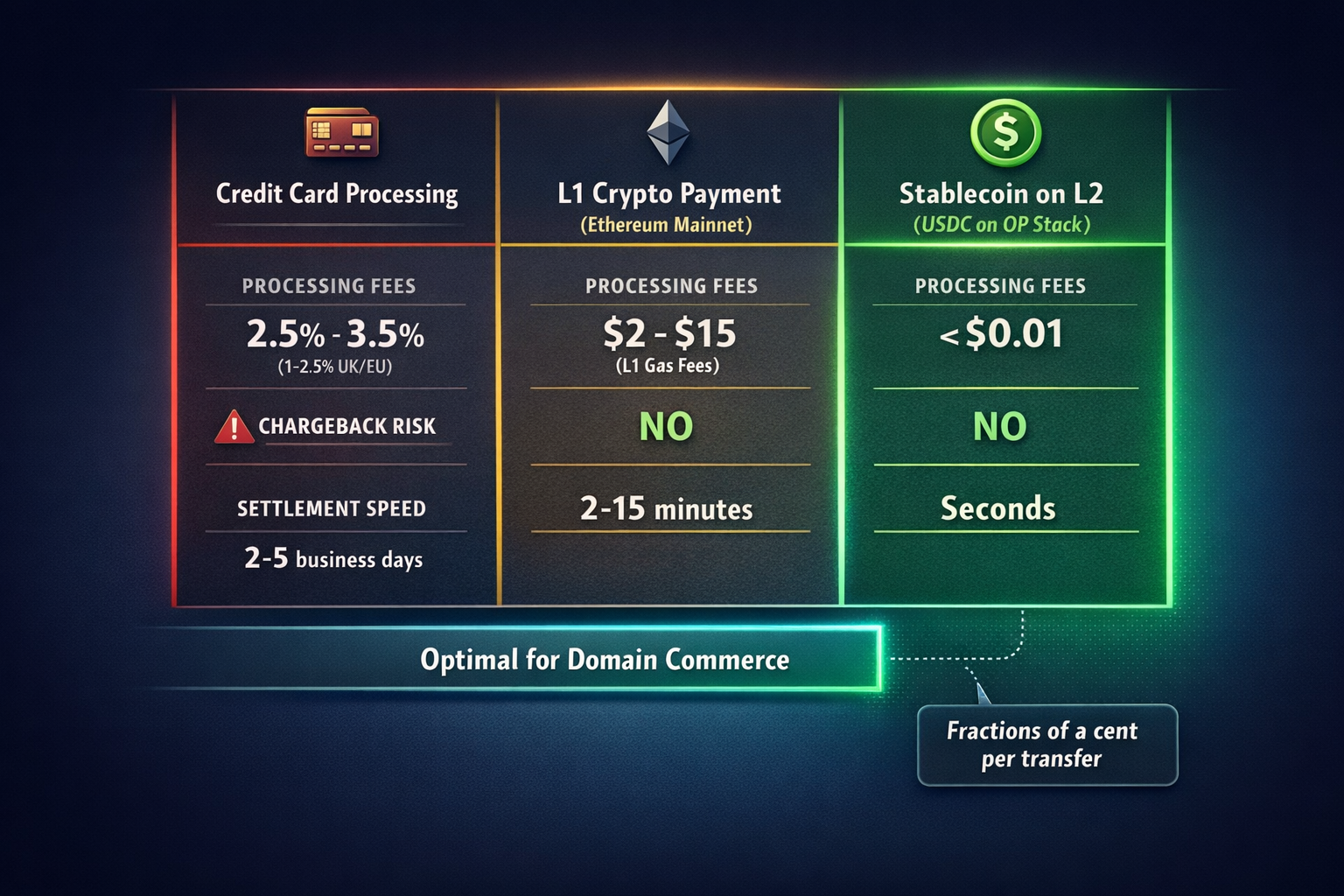
A threeway comparison showing processing fees, chargeback risk, and settlement speed across credit c
Tom is specifically bullish on stablecoins — cryptocurrencies designed to maintain a stable value, typically pegged to the US dollar — as the payment layer for domain transactions. His reasoning is sharper than generic crypto-payments optimism:
›Cheaper than card processing in many cases. Traditional US credit card payment processing runs 2.5–3.5% in fees (interchange plus processor markup). For UK and EU readers, card processing fees are generally lower — consumer debit interchange is capped at 0.2% and consumer credit at 0.3% under retained EU Interchange Fee Regulation, with total processing costs typically running 1–2.5% including acquirer markup. On Doma's OP Stack L2, stablecoin transfer fees are typically fractions of a cent. By contrast, the same stablecoin transfer on Ethereum mainnet might cost $5–50+ during peak congestion. On a $50,000 domain sale, even the lower UK card processing rate of 1.5% means $750 in fees — stablecoins on an L2 reduce this to near-zero for the transfer itself, though bridging and conversion costs should be factored in.
›Faster than bank wires. International wire transfers can take three to five business days and come with their own fees. Stablecoin settlement on an L2 happens in seconds to minutes.
›Irreversibility is a feature, not a bug. This is where most people misunderstand stablecoins in commerce. In the domain industry, chargeback fraud is a real and known problem — someone buys a high-value domain with a credit card, receives the transfer, then disputes the charge with their bank. The merchant loses both the domain and the money. With stablecoins, the payment is final. For digital goods with clear title — which is exactly what domains are — irreversibility protects the seller.
Doma Protocol enables stablecoin settlement natively on-chain. When a domain trades on Doma, the buyer can pay in stablecoins, the smart contract verifies the funds, and the DOTs transfer simultaneously. No escrow company. No chargeback window. No waiting.
UK Regulatory Considerations
For UK-based readers, the regulatory landscape for on-chain domain transactions deserves attention. If DOTs or DSTs are classified as crypto-assets under the Financial Services and Markets Act 2023 — which gives the FCA rulemaking power over crypto-assets — buying and selling them may carry regulatory requirements that do not apply to traditional domain purchases. The FCA's evolving framework for crypto-asset regulation could affect how UK residents interact with protocols like Doma, particularly if tokens are deemed "specified investments" under FSMA 2000. This area is actively developing; readers should monitor FCA guidance and consider professional advice before significant capital deployment.
For anyone looking to model how stablecoin holdings might generate yield while waiting for the right domain deal, our staking calculator can help you project returns from stablecoin staking or lending protocols.
What this means for you: Domain commerce is one of the cleanest real-world use cases for stablecoins. Digital goods, clear ownership records, global buyer pools, and high-value transactions where processing fees and chargeback risk actually matter. Stablecoin-settled domain sales are already happening on Doma's infrastructure — this is deployed infrastructure, not a roadmap bullet point.
---
08
The AI-Solopreneur Thesis: Where the Next Million Domain Buyers Come From
This was the part of my conversation with Tom that I keep coming back to. Most people frame AI as a threat to the domain industry — search engines powered by AI might reduce direct-navigation traffic, chatbots might bypass websites entirely. Tom sees something different.
His thesis: AI is displacing white-collar workers at an accelerating rate. Accountants, copywriters, analysts, designers, paralegals — roles that seemed safe two years ago are being automated or compressed. Many of these people will not find equivalent salaried positions. Instead, they will become solopreneurs — independent operators building personal brands, consulting practices, niche products, and service businesses. And every single one of them needs a domain name.
The data supports the direction of this thesis. US Census Bureau business application filings have hit record quarterly highs since 2020, with over 5 million new business applications filed in 2023 alone. In the UK, ONS data shows persistent growth in self-employment and sole-trader registrations. Goldman Sachs estimates that AI could affect approximately 300 million full-time jobs globally, while McKinsey's research suggests up to 30% of work hours could be automated by 2030. Not all of these displaced workers will become solopreneurs — but even a fraction represents millions of potential new domain buyers.
This is distinct from previous waves of domain demand:
›The 1990s–2000s wave was businesses realising they needed to be online. That created the initial rush for .com names.
›The 2010s wave was the startup boom — venture-funded companies snapping up brandable domains.
›The 2020s wave, in Tom's framing, is individual humans becoming their own brands out of necessity.
The compounding effect is worth understanding. A corporation might register one primary domain and a handful of variants. A solopreneur building multiple projects, side businesses, or client-facing tools might register five, ten, or twenty domains — and they tend to register fresh names rather than requesting subdomains from an employer. Per-capita domain demand from solopreneurs could actually exceed what corporate formation historically produced.
This thesis connects to something Elias Benger of InterNetX told me separately: vibe coding tools — AI-powered platforms that let non-developers build web projects through natural language prompts — are lowering the barrier to launching sites, which drives new domain registrations. Tom's workforce-displacement thesis and Elias's tooling thesis are two sides of the same coin.
Newer gTLDs like .ai, .shop, .live, and .coffee represent accessible inventory for this incoming wave of solopreneurs. You do not need to spend five figures on a .com when a memorable .ai or .shop name costs a fraction of that and carries its own brand signal.
What this means for you: If Tom is right — and US business formation filings have hit record quarterly highs since 2020 while self-employment in the UK continues to grow per ONS data — the domain market's next growth cohort is already forming. Being positioned ahead of that wave, whether as an investor or a platform participant, is a timing advantage that compounds.
---
09
EnCirca's Partnership with Doma: What It Signals About Institutional Readiness
Here is something casual observers miss: ICANN accreditation is hard to get and harder to keep. It requires financial reserves, technical infrastructure audits, data escrow arrangements, abuse reporting systems, and ongoing contractual compliance. EnCirca has maintained this for twenty-five years. A registrar that specialises in .bank and .pharmacy — TLDs where regulatory scrutiny is at its peak — has an even higher standard to uphold.
Tom would not stake that track record on infrastructure that creates compliance conflicts. His partnership with Doma is, in itself, a signal about Doma's architecture: it works within the ICANN system, not around it.
EnCirca joins five other registrar partners — NicNames (the number-one Doma tokenisation registrar by volume), InterNetX (part of the IONOS Group, managing millions of domains), Rumahweb, ConnectReseller, and Interstellar. What is notable about this group is the diversity: NicNames brings volume and consumer-friendly onboarding, InterNetX brings enterprise scale, and EnCirca brings regulated-TLD expertise and institutional credibility.
The platform model is what makes this ecosystem work. Doma provides shared infrastructure. Registrars compete on services, pricing, support, and specialisation — not on namespace control. This is how adoption scales: not by one company trying to do everything, but by building a layer that many companies build on.
With only an estimated ~107,000 domains tokenised (according to Doma) out of ~360 million registered worldwide, the infrastructure is in its early stages and the addressable market — particularly the tradeable aftermarket portion — is largely untouched.
What this means for you: Follow the institutions, not just the technology. When regulated-industry veterans start building on a protocol, it means the protocol has passed compliance tests that most users never think to ask about.
---
10
Five Hard Questions to Ask About Any Domain + Blockchain Project
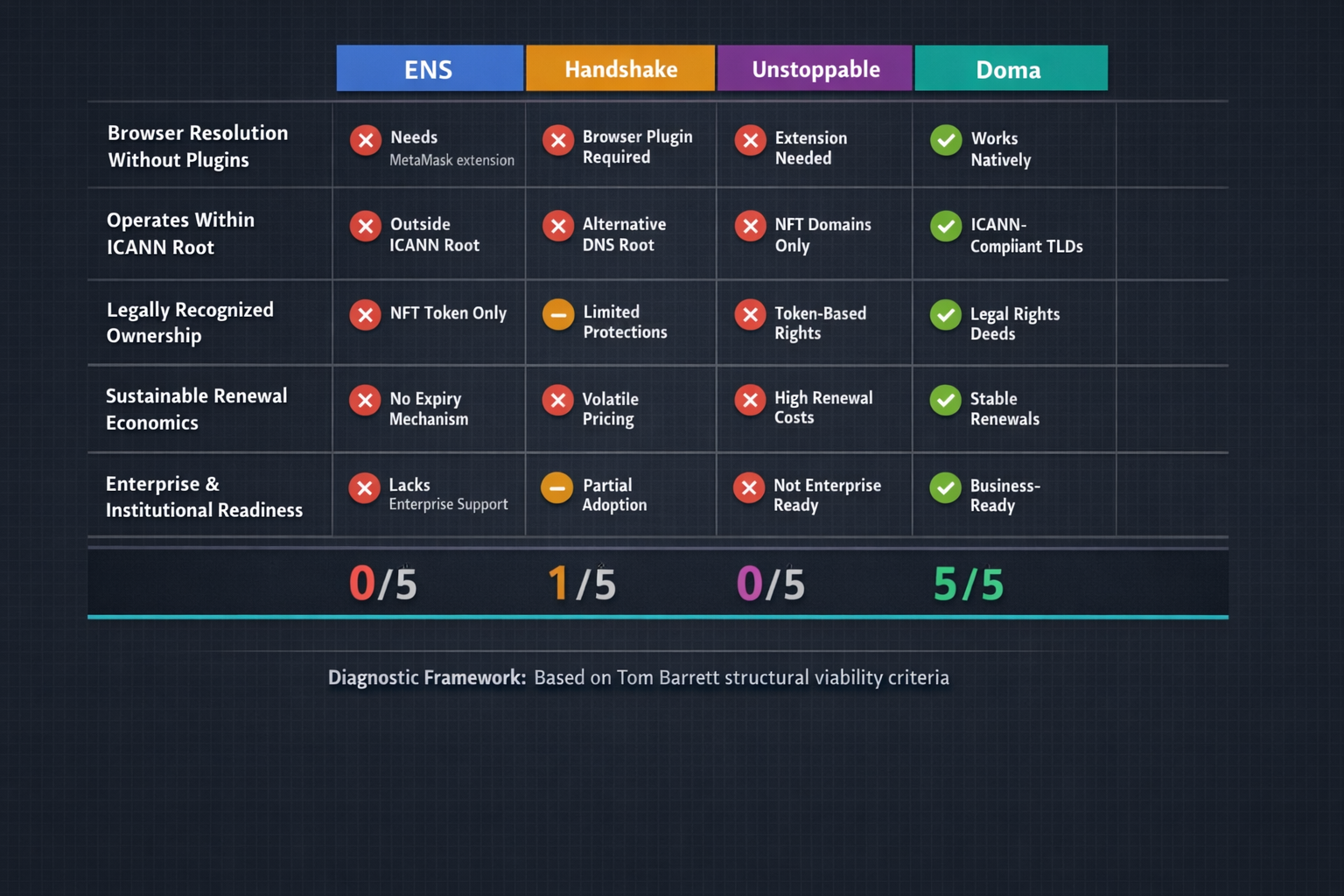
A structured evaluation matrix scoring ENS, Handshake, Unstoppable Domains, and Doma against five di
Tom's career gives us a practical framework. Whether you are evaluating Doma, ENS, Handshake, or something that does not exist yet, these five questions cut through marketing and get to structural viability:
1. Does it resolve in every browser without the user installing anything? Browser resolution is binary. There is no "almost works everywhere." If a naming system requires a plugin, extension, or special wallet to resolve, it cannot be someone's primary online identity. ENS requires MetaMask or compatible tools. Handshake requires alternative resolvers. ICANN domains — including those tokenised on Doma — resolve natively in every browser, email client, and application worldwide.
2. Does it operate within the ICANN root? If a project creates its own namespace outside ICANN, it faces collision risk (its TLDs may clash with future ICANN delegations), has no legal enforcement mechanism for abuse, and depends on adoption of its own resolution chain to be useful. Doma tokenises domains that already exist in the ICANN root — the blockchain layer adds functionality without abandoning compatibility.
3. Is there a dispute resolution mechanism for trademarks? Institutions will not build their digital presence on a naming system where someone can squat on their trademark with zero consequences. UDRP is not glamorous, but it is the reason banks, hospitals, and governments trust the ICANN namespace. No UDRP, no institutional adoption.
4. Is the blockchain infrastructure a registrar or a platform? A project that operates as a registrar competes with its own potential partners. A project that operates as infrastructure — like Doma — enables registrars to build on top of it. The platform model creates network effects; the registrar model creates competition.
5. Can you use stablecoins, or is it limited to volatile tokens? Practical commerce requires stable units of account. If the only way to buy a domain on a platform is with a volatile governance token, the system is optimised for speculation, not commerce.
What this means for you: Print this list. Use it every time someone pitches you a Web3 naming project. If the project fails even one of these tests, proceed with extreme caution.
---
Tom Barrett's Evaluation Framework
✓
Does it resolve in every browser without plugins or extensions?
✓
Does it operate within the ICANN root (not a parallel namespace)?
✓
Is there UDRP or equivalent trademark dispute resolution?
✓
Is the blockchain layer infrastructure (platform) or a competing registrar?
✓
Does it support stablecoin payments for practical commerce?
✓
Is it backed by ICANN-accredited registrar partners?
✓
Can you verify on-chain data — volume and wallets and transactions?
11
Tax Implications of On-Chain Domain Trading
This is not optional reading — it is a practical necessity for anyone considering tokenised domain transactions.
Selling a domain as an on-chain token likely triggers Capital Gains Tax in most jurisdictions. In the UK, HMRC treats crypto-asset disposals as taxable events. A domain sold via Doma may constitute a disposal of both a digital asset (the domain itself) and a crypto-asset (the on-chain token) simultaneously. Key considerations:
›UK readers: HMRC's guidance on crypto-assets is clear that disposing of tokens — whether by selling, swapping, or gifting — can trigger CGT. The annual exempt amount for CGT has been significantly reduced in recent years (£3,000 for 2024/25). Domain traders who are used to the traditional aftermarket may not realise that moving to on-chain settlement changes their tax reporting obligations.
›Stablecoin conversions: Converting fiat to stablecoins, then using stablecoins to purchase a domain token, may create multiple taxable events — each conversion could be a disposal.
›Record-keeping: On-chain transactions are pseudonymous but not invisible. HMRC has data-sharing agreements with major exchanges, and on-chain transactions are permanently recorded.
Readers acting on this article without understanding the tax implications could face unexpected liabilities. This is not tax advice — consult a qualified tax professional familiar with both domain transactions and crypto-asset taxation in your jurisdiction.
---
12
What Tom's Career Teaches About Evaluating New Technology
The throughline of Tom's career — jet engine automation, Thomson Reuters, trademark law services, regulated domain registrations — is not a random walk. It is a consistent application of one principle: technology must work within systems of accountability to reach the people who need it most.
This is where a perspective clash in crypto becomes productive rather than toxic. The crypto-native instinct says: decentralise everything, remove intermediaries, let code enforce rules. Tom's engineering and legal background says: code must coexist with law, because mainstream users and institutions will not abandon legal protections for ideological purity.
Doma Protocol sits at the intersection. On-chain ownership, instant settlement, programmable tokens — all the efficiency gains of blockchain. ICANN compliance, UDRP protection, registrar accountability — all the trust guarantees of the traditional system. Tom's endorsement is not about ideology. It is about structural analysis: does this technology meet the bar that regulated industries require?
When your tokenised domain portfolio represents real financial value — and premium domains routinely trade at five, six, and seven figures — storing your DOTs and DSTs on a hardware wallet like a Ledger is the same common sense as keeping the deed to your house in a safe.
What this means for you: Apply Tom's evaluation lens beyond domains. Any crypto project worth your time should be able to answer: Does this work within existing legal and regulatory frameworks, or does it depend on those frameworks being dismantled? The former is a business. The latter is a bet.
---
13
Getting Started: How to Explore Tokenised Domains Today
You do not need to commit capital to start learning. Here is a sequence that builds understanding step by step — the order matters because each step provides context for the next:
1. Browse the Doma marketplace. Visit app.doma.xyz and look at real tokenised domains. Check prices, see which TLDs are represented, and read the on-chain data. This gives you a feel for what the market looks like before you risk anything.
2. Understand EnCirca's model. Visit encirca.com to see how a regulated-TLD registrar operates. Even if you never register a .bank domain, understanding the verification layer helps you grasp why trust infrastructure matters.
3. Start with affordable extensions. Newer gTLDs like .xyz, .fun, or .ai offer entry points at a fraction of premium .com prices. Register something you genuinely find interesting — a domain you might actually build on — rather than speculating on names you do not understand.
4. Set up proper wallet infrastructure first. Before acquiring any on-chain domain asset, ensure your wallet is secured. Hardware wallets for significant holdings. Separate wallets for trading versus long-term storage. Basics that protect you from costly mistakes.
5. Track everything from day one. Domain trades — whether traditional or on-chain — can trigger capital gains events. Use a tool like Koinly to automatically import your on-chain transactions and calculate tax obligations before they become a headache at year-end. This is especially important for UK readers given HMRC's treatment of crypto-asset disposals.
6. Understand renewal obligations. Any tokenised domain you acquire must still be renewed through the registrar. Set reminders, verify renewal processes with the registrar partner, and never assume the on-chain token alone guarantees ongoing ownership.
What this means for you: The barrier to participation is lower than it has ever been. The infrastructure exists, the registrar partners are live, and the marketplace is active. The best time to understand a market is before the wave Tom predicts — millions of new solopreneurs needing domains — arrives in force.
---
14
Quick Recap
›Apply Tom's five-point test before investing in any Web3 naming project — browser resolution is binary.
›Doma tokenises real ICANN domains, preserving legal protections while adding on-chain tradability — but the bridge between on-chain tokens and off-chain DNS control is a trust assumption, not a trustless system.
›Regulated TLDs prove trust must be architected, not bolted on — EnCirca's 25-year track record confirms this.
›AI-displaced workers becoming solopreneurs will drive the next massive wave of domain demand — US business formation data and UK self-employment trends already point in this direction.
›Stablecoins eliminate chargeback fraud and reduce processing fees, making domain commerce faster, cheaper, and safer — though total costs including bridging and conversion should be factored in.
›Tokenised domains still expire — on-chain ownership does not remove the obligation to renew the underlying domain registration.
›Tax implications are real — on-chain domain transactions may trigger CGT in the UK and equivalent obligations elsewhere. Track and consult a professional.