Elias put this bluntly: "You need to be very big to make the other network irrelevant — and currently everything of relevance is on ICANN and DNS."
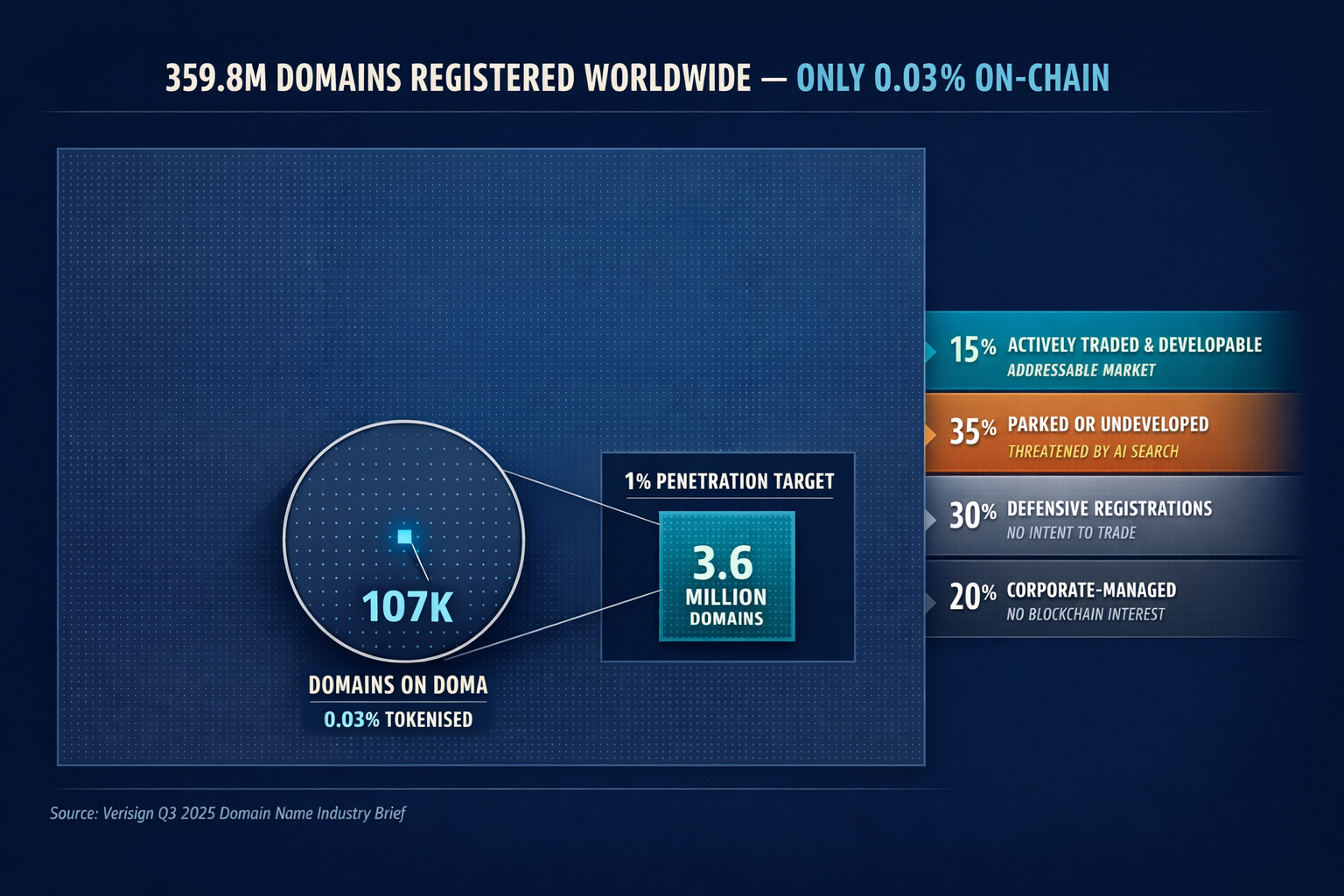
ICANN (the Internet Corporation for Assigned Names and Numbers) maintains the single authoritative root of the internet's naming system. Every browser, every device, every operating system resolves ICANN-managed domains natively. According to Verisign's Domain Name Industry Brief for Q3 2025, approximately 359.8 million domain names were registered — a figure likely near or slightly above 360 million by early 2026. The UDRP (Uniform Domain-Name Dispute Resolution Policy) provides trademark enforcement. If someone squats on your brand name, there's a legal process to get it back.
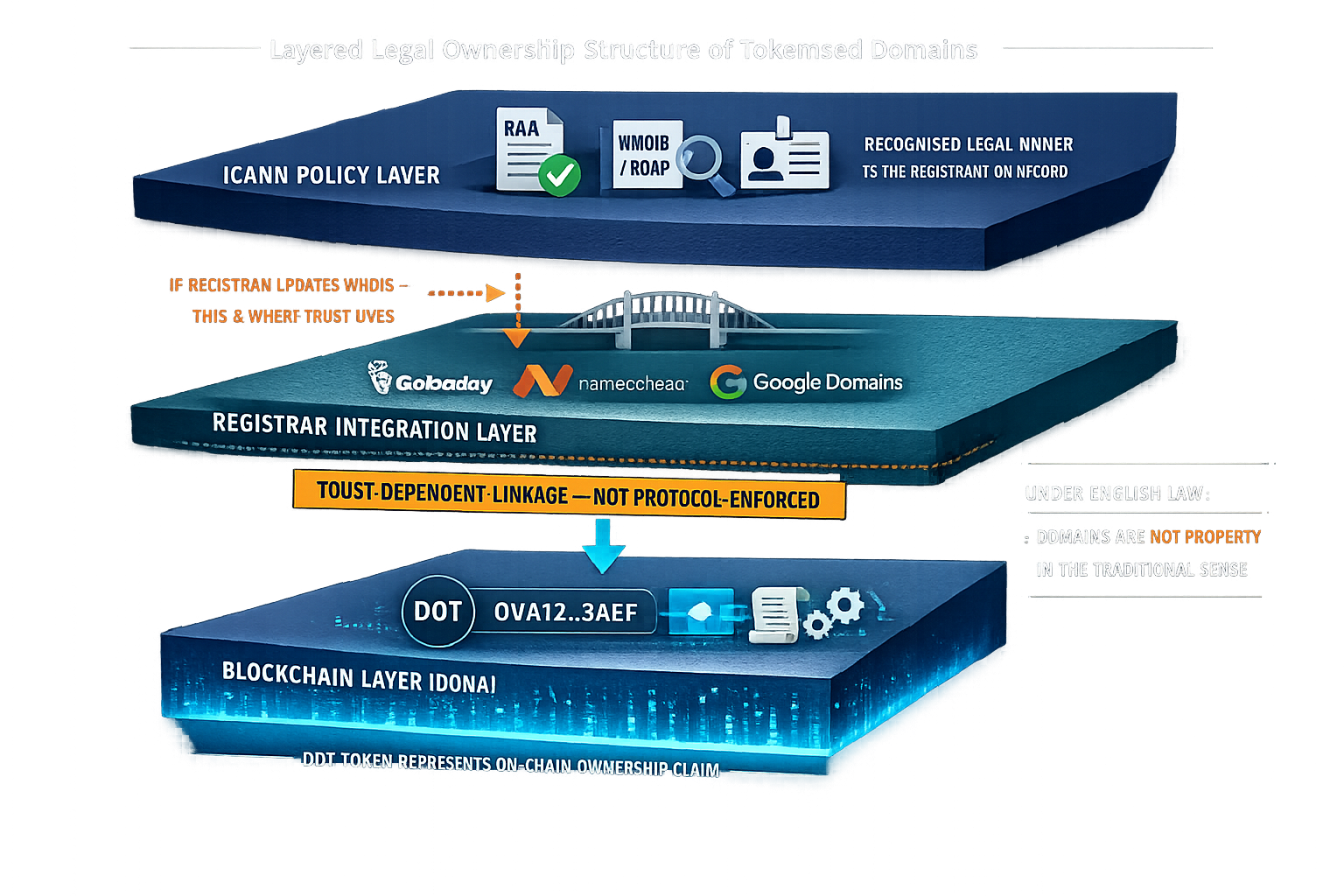
An open question for tokenised domains: What happens when a UDRP panel orders the transfer of a domain that has been tokenised on Doma? The UDRP process operates through registrars — a panel decision instructs the registrar to transfer the domain to the complainant. But if ownership DOTs are held in a third party's wallet, who enforces the on-chain transfer? Can (and will) the registrar override the blockchain record? As of April 2026, there are no published UDRP decisions involving tokenised domains, making this genuinely uncharted territory. If you tokenise domains that could face trademark disputes, understand that the registrar retains the ability to comply with UDRP orders at the ICANN level regardless of on-chain token holdings.
Now compare Doma's approach to the blockchain naming alternatives:
Comparison: Doma vs ENS vs Handshake vs Unstoppable Domains
| Feature | Doma Protocol | ENS (.eth) | Handshake (HNS) | Unstoppable Domains |
|---|---|---|---|---|
| Domain type | Tokenises existing ICANN domains (.com, .ai, .xyz, etc.) | Native .eth names on Ethereum | Native TLDs on Handshake blockchain | Native extensions (.crypto, .x, .wallet, etc.) |
| Browser resolution | Universal — domains already resolve in all browsers via DNS | Partial — natively supported in Brave and Opera; eth.limo gateway for others; not natively resolved in Chrome, Safari, or Firefox without add-ons | Requires HNS-aware resolvers or extensions | Requires compatible browsers/extensions or IPFS gateways |
| Relationship to ICANN | Works within ICANN root — tokenises ICANN-registered domains | Parallel system — no ICANN relationship | Alternative root — potential TLD collision with future ICANN delegations | Parallel system — no ICANN relationship |
| Dispute resolution | UDRP applies (via underlying ICANN domain) | No UDRP equivalent | No UDRP equivalent | No UDRP equivalent |
| Ownership model | DOTs (ownership) + DSTs (DNS control) — linked to registrar WHOIS | NFT-based (ERC-721) | NFT-based on Handshake chain | NFT-based (minted on Ethereum/Polygon) |
| Primary use case | On-chain trading, fractionalization, and programmable ownership of real DNS domains | Crypto wallet identity, decentralised websites | Decentralised TLD ownership | Crypto wallet identity, decentralised websites |
| Ecosystem size (approx.) | 107,000+ tokenised domains (per Doma, March 2026) | 2M+ .eth registrations | ~10M+ HNS names | 4M+ domains minted |
| Cold-start problem | None — uses existing DNS infrastructure | Moderate — growing browser support but not universal | Significant — requires alternative root adoption | Moderate — similar to ENS |
None of these are bad projects. But Elias's framing is about network effects, not technology quality. The ICANN root already won the network-effects battle decades ago. Any alternative root must convince billions of devices to recognise it. That's not a technology problem — it's a coordination problem of enormous scale.
It's worth noting that ENS's browser resolution situation has improved since its early days. Brave and Opera offer native or near-native .eth support, and the eth.limo gateway provides access through any browser. However, mainstream browsers (Chrome, Safari, Firefox) still do not natively resolve .eth addresses, which remains a significant adoption barrier for general audiences.
Handshake's TLD collision risk deserves precision: Handshake auctions TLDs that may overlap with ICANN's future delegations, not necessarily current ones. The collision risk is prospective — if ICANN delegates a new TLD that Handshake has already auctioned, two systems claim authority over the same suffix. Active collisions are not widespread today, but the structural risk is real.
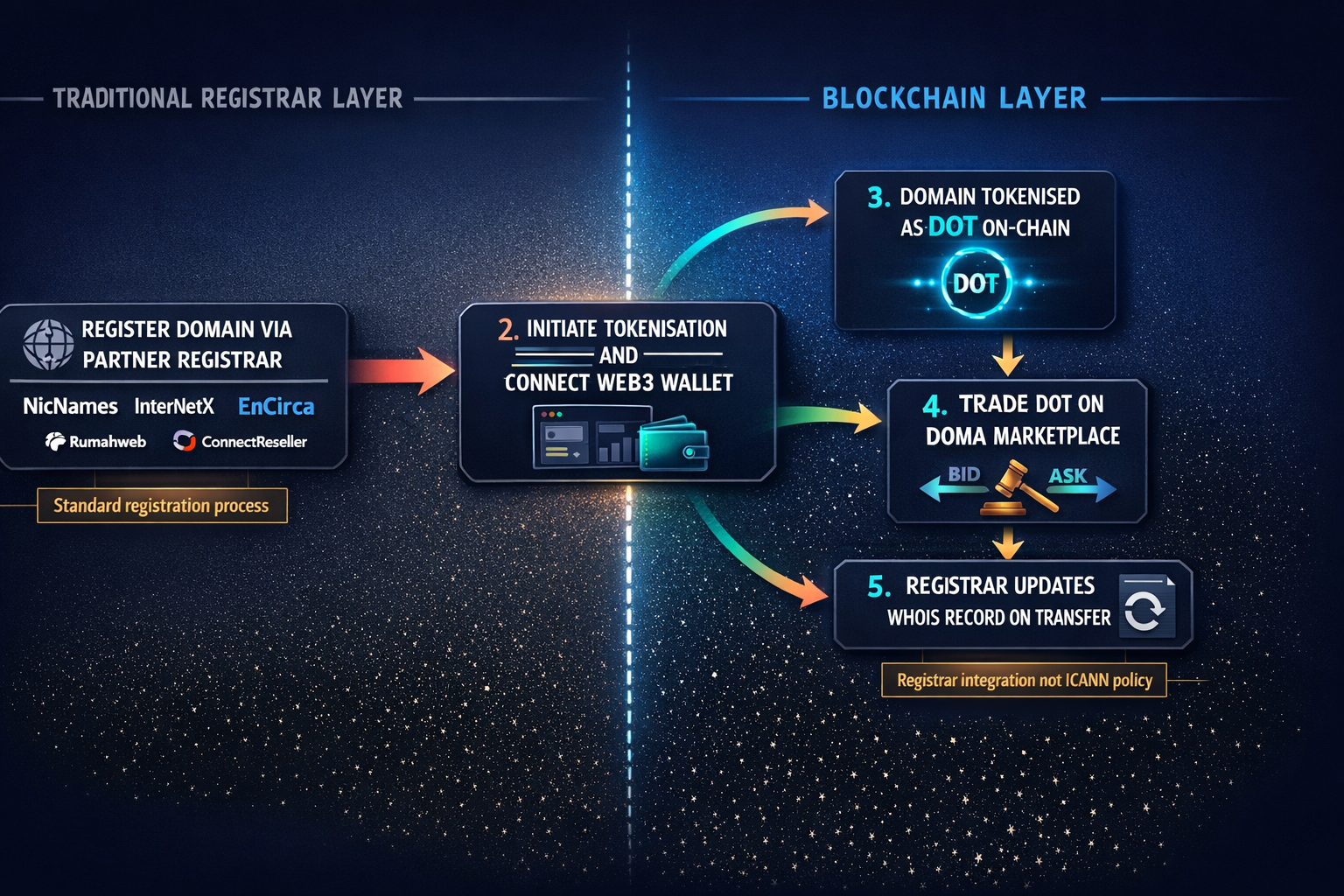
Doma's insight: don't fight DNS. Tokenise what already works inside ICANN. Your .com resolves in every browser today and also lives on-chain as a programmable asset. No plugins. No alternative roots. No fragmentation.
What this means for you: If you own a .com, .ai, or .xyz domain, tokenising it on Doma doesn't change how it works for visitors. It changes how you own, trade, and manage it — using blockchain rails instead of brokers and escrow. If you're evaluating blockchain domain options, the table above should help you understand the trade-offs between systems that work within ICANN and those that operate outside it.